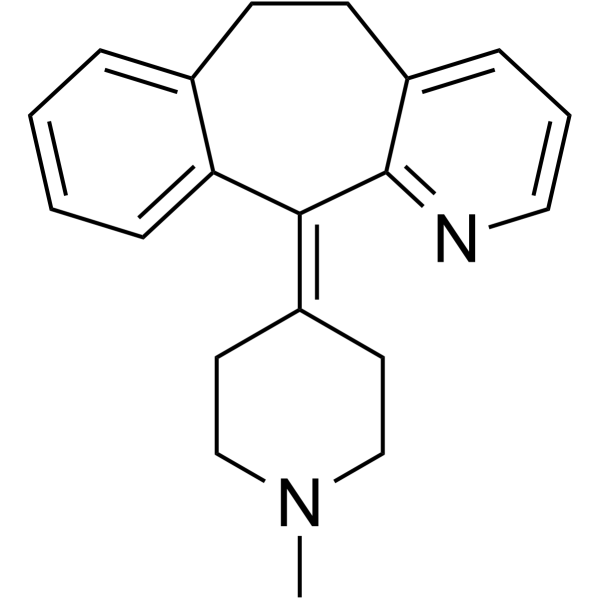
Histamine Receptor
Histamine Receptors are a class of G protein-coupled receptors with histamine as their endogenous ligand. There are four known histamine receptors: H1 receptor, H2 receptor, H3 receptor, H4 receptor. The H1 receptor is a histamine receptor belonging to the family of Rhodopsin-like G-protein-coupled receptors. This receptor, which is activated by the biogenic amine histamine, is expressed throughout the body, to be specific, in smooth muscles, on vascular endothelial cells, in the heart, and in the central nervous system. H2 receptors are positively coupled to adenylate cyclase via Gs. It is a potent stimulant of cAMP production, which leads to activation of Protein Kinase A. Histamine H3 receptors are expressed in the central nervous system and to a lesser extent the peripheral nervous system, where they act asautoreceptors in presynaptic histaminergic neurons, and also control histamine turnover by feedback inhibition of histamine synthesis and release. The Histamine H4 receptor has been shown to be involved in mediating eosinophil shape change and mast cell chemotaxis.
Histamine Receptor Isoform Specific Products
All Product Categories
-
Histamine Receptor Inhibitors
(197)
View all products
-
Histamine Receptor Agonists
(66)
View all products
-
Histamine Receptor Antagonists
(495)
View all products
-
Histamine Receptor Activators
(5)
View all products
-
Histamine Receptor Modulators
(20)
View all products
-
Histamine Receptor Controls
(9)
View all products
-
Histamine Receptor Ligands
(2)
View all products
-
Histamine Receptor Related Products (860)
Related Products (860)

-
Antibodies (2)
-
Histamine Receptor Isoform Comparison
-
Levodropropizine-d5
 0 ImagesCat. No.: HY-B1895S1Synonyms: (S)-(-)-Dropropizine-d5; DF-526-d5Levodropropizine-d5 ((S)-(-)-Dropropizine-d5) is deuterium labeled Levodropropizine. Levodropropizine (DF-526) is an orally active histamine receptor inhibitor, Levodropropizine is an effective and very well tolerated peripheral antitussive agent.
-
Pitolisant-d6
 0 ImagesCat. No.: HY-12199S1CAS No.: 2416991-77-8Synonyms: Tiprolisant-d6Pitolisant-d6 (Tiprolisant-d6) is deuterium labeled Pitolisant. Pitolisant is a potent and selective nonimidazole inverse agonist at the recombinant human histamine H3 receptor (Ki=0.16 nM).
-
Azelastine hydrochloride (Standard)
 0 ImagesCat. No.: HY-B0462RCAS No.: 79307-93-0Azelastine (hydrochloride) (Standard) is the analytical standard of Azelastine (hydrochloride). This product is intended for research and analytical applications. Azelastine hydrochloridem, an antihistamine, is a potent and selective histamine 1 (H1) antagonist. Azelastine hydrochloride can be used for the research of allergic rhinitis, asthma, diabetic hyperlipidemic and SARS-CoV-2.
-
VUF 5681 dihydrobromide
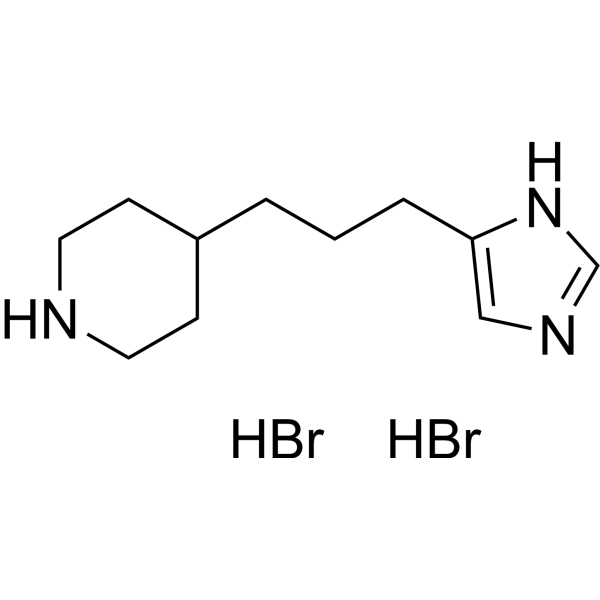 0 ImagesCat. No.: HY-107556CAS No.: 639089-06-8VUF 5681 dihydrobromide is a neutral antagonist of histamine H3 receptor. VUF 5681 dihydrobromide also has partial agonist function of H3 receptor. VUF 5681 dihydrobromide blocks the effects of Thioperamide (HY-12206). VUF 5681 dihydrobromide is used in central nervous system disease research.
-
Thiethylperazine-d3
 0 ImagesCat. No.: HY-B1794SThiethylperazine-d3 is the deuterium labeled Thiethylperazinee (HY-B1794). Thiethylperazine, a phenothiazine derivate, is an orally active and potent dopamine D2-receptor and histamine H1-receptor antagonist. Thiethylperazine is also a selective ABCC1activator that reduces amyloid-β (Aβ) load in mice. Thiethylperazine has anti-emetic, antipsychotic and antimicrobial effects.
-
Chlorphenoxamine (Standard)
 0 ImagesChlorphenoxamine (Standard) is the analytical standard of Chlorphenoxamine (HY-B1607). This product is intended for research and analytical applications. Chlorphenoxamine, an antihistamine and anticholinergic agent is a GPCR antagonist. Chlorphenoxamine inhibits multiple lethal viral diseases, such as SARS-CoV, MERS-CoV, EBOV and malaria. Chlorphenoxamine shows anti-filovirus activity against both EBOV and Marburg virus (MARV) with IC50s of 1.1 μM and 6.2 μM, respectively. Chlorphenoxamine is used for allergic conditions, urticaria, viral diseases and Parkinson’s disease.
-
Olopatadine-d3 (hydrochloride)
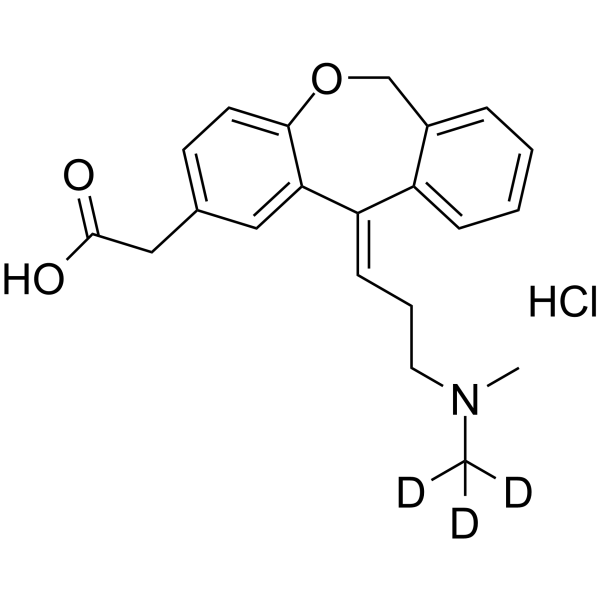 0 ImagesCat. No.: HY-B0426ASCAS No.: 1331635-21-2Olopatadine-d3 hydrochloride (ALO4943A-d3) is the deuterium labeled Olopatadine hydrochloride. Olopatadine hydrochloride (ALO4943A; KW4679) is an orally active histamine H1 receptor antagonist and mast cell stabilizer. Olopatadine hydrochloride exerts antiallergic effects by blocking histamine H1 receptor-mediated activities. Olopatadine hydrochloride inhibits exocytosis, chemokine release, F-actin polymerization, CXCL10-induced calcium influx, and T cell chemotactic activity. Olopatadine hydrochloride also reduces the expression levels of CXCR3 on the surface of CD4+ and CD8+ T cells. Olopatadine hydrochloride inhibits scratching behavior, improves dermatitis scores, and suppresses intraepidermal neurite outgrowth. Olopatadine hydrochloride simultaneously decreases the levels of inflammatory markers, growth factors, histamine, and specific IgE, while increasing the expression of ErbB3A/HER3A. Olopatadine hydrochloride can be used in research related to seasonal pollinosis, chronic rhinitis, urticaria, allergic conjunctivitis, alopecia areata, and atopic dermatitis.
-
VUF10460 (Standard)
 0 ImagesCat. No.: HY-101420RCAS No.: 1028327-66-3

-
GSK189254A hydrochloride
 0 ImagesCat. No.: HY-12200CAS No.: 945493-87-8Synonyms: GSK189254GSK189254A hydrochloride is a novel, potent and selective histamine H3 receptor antagonist with pKi values of 9.59-9.90 and 8.51-9.17 for human and rat H3, respectively.
-
Pitolisant hydrochloride (Standard)
 0 ImagesSynonyms: Ciproxidine (Standard); BF 2649 (Standard)Pitolisant (hydrochloride) (Standard) is the analytical standard of Pitolisant (hydrochloride). This product is intended for research and analytical applications. Pitolisant hydrochloride is a potent and selective nonimidazole inverse agonist at the recombinant human histamine H3 receptor (Ki=0.16 nM).
-
Bepotastine besilate (Standard)
 0 ImagesBepotastine (besilate) (Standard) is the analytical standard of Bepotastine (besilate). This product is intended for research and analytical applications. Bepotastine besilate is a selective and orally active second-generation histamine H1 receptor antagonist, can suppress the expression of nerve growth factor (NGF). Bepotastine besilate has the potential for allergic rhinitis, allergic conjunctivitis and urticaria/pruritus research.
-
Roxatidine Acetate Hydrochloride (Standard)
 0 ImagesSynonyms: HOE 760 (Standard)Roxatidine (Acetate Hydrochloride) (Standard) is the analytical standard of Roxatidine (Acetate Hydrochloride). This product is intended for research and analytical applications. Roxatidine Acetate Hydrochloride is a potent, selective, competitive and orally active histamine H2-receptor antagonist. Roxatidine Acetate Hydrochloride has antisecretory potency against gastric acid secretion. Roxatidine Acetate Hydrochloride can also suppress inflammatory responses and can be used for gastric and duodenal ulcers research. Roxatidine Acetate Hydrochloride has antitumor activity.
-
Toladryl
 0 ImagesCat. No.: HY-138110CAS No.: 19804-27-4Synonyms: 4-MethyldiphenhydramineToladryl is a derivative of Diphenhydramine (HY-B0303), capable of penetrating the blood-brain barrier and possessing oral activity, as well as antihistamine and anticholinergic activities. The anticholinergic activity of Toladryl is approximately one-tenth that of Diphenhydramine (HY-B0303), and its protective effect against lethal doses of histamine in guinea pigs is 2 to 4 times that of Diphenhydramine (HY-B0303). The side effects of Toladryl are fewer and milder than those of Diphenhydramine (HY-B0303), but at higher doses, it may cause central nervous system symptoms such as insomnia, agitation, and disorientation. Toladryl can be used for research in allergic diseases.
-
UR-PI376
 0 ImagesCat. No.: HY-120531CAS No.: 1192559-94-6UR-PI376 is a potent and selective histamine H4 receptor (H4R) agonist with a pEC50 value of 7.47. UR-PI376 shows negligible hH1R and hH2R activities and moderate inverse agonistic activity at the hH3R.
-
TEI-6472
 0 ImagesCat. No.: HY-105460CAS No.: 151379-49-6TEI-6472, a naphthalene derivative, can suppress IgE responses both in vitro and in vivo. TEI-6472 causes significant inhibition of FceRI-mediated histamine release.
-
Metiamide (Standard)
 0 ImagesCat. No.: HY-15540RCAS No.: 34839-70-8Synonyms: SK&F 92058 (Standard)Metiamide (Standard) is the analytical standard of Metiamide. This product is intended for research and analytical applications. Metiamide (SK&F 92058) is a histamine H2-receptor antagonist developed from another H2 antagonist, burimamide.
-
(R)-(+)-Dimethindene maleate (Standard)
 0 ImagesCat. No.: HY-107647ARCAS No.: 136152-64-2(R)-(+)-Dimethindene maleate (Standard) is the analytical standard of (R)-(+)-Dimethindene (maleate) (HY-107647A). This product is intended for research and analytical applications. (R)-(+)-Dimethindene maleate is an orally active H1-receptor blocker with antihistaminic properties in pigs.
-
Cetirizine Impurity D (Standard)
 0 ImagesCat. No.: HY-100661RCAS No.: 346451-15-8Cetirizine Impurity D (Standard) is the analytical standard of Cetirizine Impurity D. This product is intended for research and analytical applications. Cetirizine Impurity D is an impurity of Cetirizine. Cetirizine, a second-generation antihistamine, is a specific, orally active and long-acting histamine H1-receptor antagonist. Cetirizine marks antiallergic properties and inhibits eosinophil chemotaxis during the allergic response.